When downloading videos online, you are almost always presented with multiple quality options: 360p, 480p, 720p, 1080p, 1440p, 4K, and sometimes even 8K. But what do these numbers actually mean? And which should you choose?
This comprehensive guide explains everything you need to know about video quality — resolutions, bitrates, file formats, and codecs — so you can make the best decision every time you download a video.
What Do the Numbers Mean? (Resolution Explained)
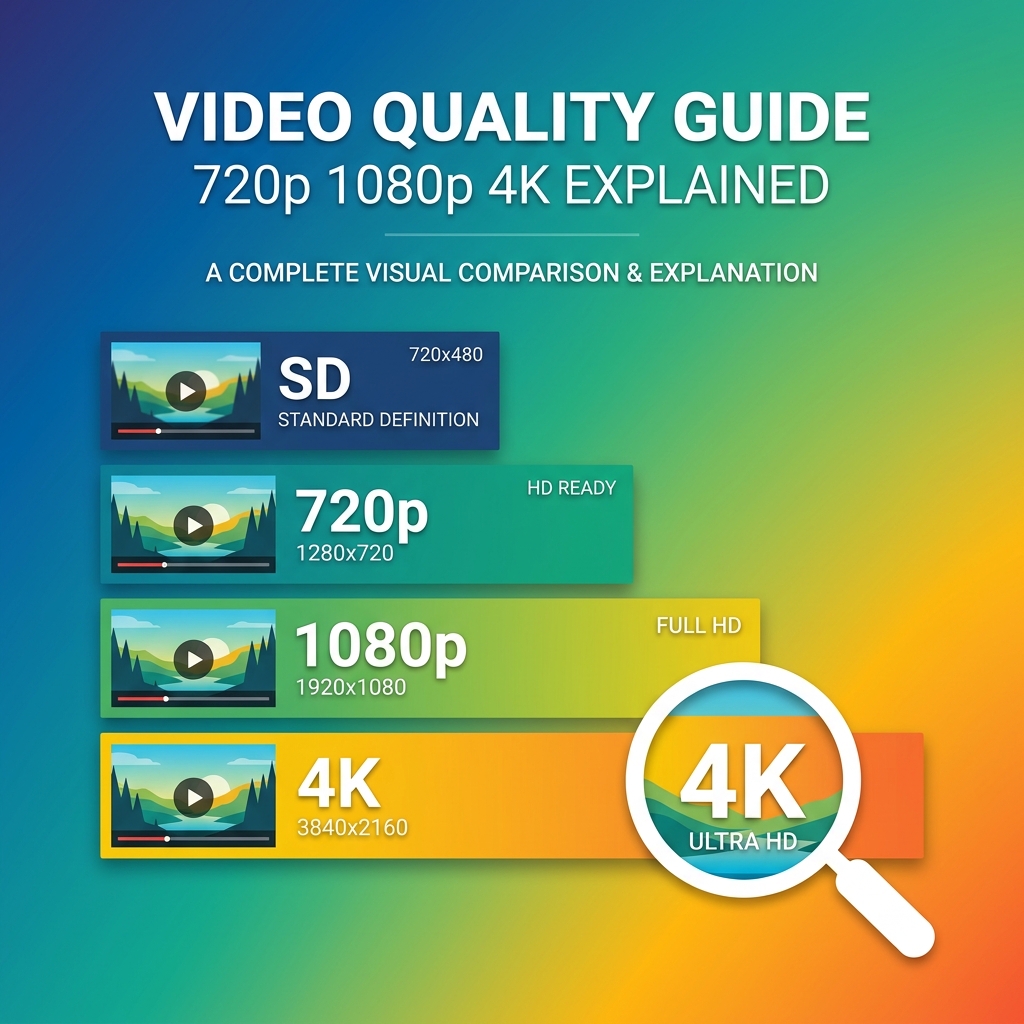
Video quality is primarily measured by resolution — the number of pixels that make up each frame of the video. The number you see (720p, 1080p, etc.) refers to the vertical pixel count:
| Label | Resolution | Total Pixels | Common Name |
|---|---|---|---|
| 360p | 640 × 360 | 230,400 | Low Definition |
| 480p | 854 × 480 | 409,920 | Standard Definition (SD) |
| 720p | 1280 × 720 | 921,600 | HD (High Definition) |
| 1080p | 1920 × 1080 | 2,073,600 | Full HD (FHD) |
| 1440p | 2560 × 1440 | 3,686,400 | 2K / QHD |
| 2160p | 3840 × 2160 | 8,294,400 | 4K / Ultra HD (UHD) |
| 4320p | 7680 × 4320 | 33,177,600 | 8K |
The "p" stands for progressive scan, meaning each frame is drawn completely in one pass (as opposed to "i" for interlaced, which is an older technology).
The "p" vs "i" Difference
You might occasionally see "1080i" instead of "1080p":
- 1080p (Progressive) — Each frame contains all 1,920 × 1,080 pixels. Sharper, better for fast motion. Used by streaming platforms and digital video
- 1080i (Interlaced) — Each frame only draws half the lines, alternating odd/even lines. Used in older TV broadcasts. Can cause visible "combing" artifacts during fast motion
For downloaded videos, you almost always want progressive (p). Modern platforms like Instagram, TikTok, and Facebook all use progressive scan exclusively.
Resolution vs Bitrate: Why Resolution Alone Doesn't Tell the Full Story
Resolution determines how many pixels are in the frame, but bitrate determines how much data is used to render each pixel. A 1080p video with a low bitrate can look worse than a 720p video with a high bitrate.
What Is Bitrate?
Bitrate is measured in Mbps (megabits per second) and represents how much data the video uses per second of playback:
| Resolution | Low Bitrate | Medium Bitrate | High Bitrate |
|---|---|---|---|
| 720p | 2.5 Mbps | 5 Mbps | 8 Mbps |
| 1080p | 4 Mbps | 8 Mbps | 15 Mbps |
| 4K | 15 Mbps | 25 Mbps | 50+ Mbps |
Platforms like Instagram and Facebook heavily compress videos to save bandwidth, meaning their "1080p" often has a lower bitrate than professional sources like Vimeo. This is why the same video can look noticeably better on Vimeo — it is higher bitrate, even at the same resolution.
Which Quality Should You Download?
The best quality depends on your specific use case:
Choose 720p When:
- Watching on a phone (most phone screens are too small to notice the difference between 720p and 1080p)
- You have limited storage space
- You need a quick download with minimal data usage
- The video is primarily talking head content with little motion
Choose 1080p When:
- Watching on a laptop or desktop monitor
- You want the best balance of quality vs file size
- The content has fast motion (gaming, sports, music videos)
- You plan to keep the video long-term
Choose 4K When:
- Watching on a 4K TV or large monitor (27" or larger)
- You need maximum quality for archiving
- The content is visually stunning (nature documentaries, cinematography, travel videos)
- You plan to edit or crop the video (4K gives you room to crop while maintaining HD quality)
Video File Formats Explained
When downloading videos, you will encounter these common formats:
MP4 (MPEG-4 Part 14)
The universal standard. Works on every device, every operating system, every video player. MP4 typically uses H.264 video codec with AAC audio. This is what GripVid and most download tools provide by default.
Best for: Everything. If in doubt, choose MP4.
WebM
Google's open-source format, used internally by several large streaming platforms. Uses VP9 or AV1 video codec. Good quality but less universal compatibility than MP4.
Best for: Web embedding, when smaller file sizes are needed.
MKV (Matroska)
A flexible container format popular for high-quality video. Supports multiple audio tracks, subtitles, and chapters. Not natively supported by all mobile devices.
Best for: Desktop viewing, archiving with multiple audio/subtitle tracks.
MOV (QuickTime)
Apple's proprietary format. Works great on Mac and iPhone but may have compatibility issues on Windows and Android.
Best for: Apple ecosystem users only.
Video Codecs: H.264 vs H.265 vs AV1
The codec is the algorithm used to compress and decompress video data:
| Codec | Compression | Quality | Compatibility | CPU Usage |
|---|---|---|---|---|
| H.264 (AVC) | Good | Great | Universal | Low |
| H.265 (HEVC) | 50% better than H.264 | Excellent | Good (newer devices) | Medium |
| VP9 | Similar to H.265 | Excellent | Good (Chrome, Android) | Medium |
| AV1 | 30% better than H.265 | Best | Limited (newest devices) | High |
Recommendation: For maximum compatibility, stick with H.264/MP4 downloads. These play on literally every device manufactured in the last 15 years.
Frame Rate: 30fps vs 60fps
Frame rate measures how many images (frames) are shown per second:
- 24 fps — Cinematic look, used in movies and filmmaking
- 30 fps — Standard for most online video content, vlogs, and tutorials
- 60 fps — Smooth motion, ideal for gaming, sports, and fast-action content
Higher frame rates produce smoother video but create larger files. A 60fps 1080p video is roughly double the file size of a 30fps 1080p video. Most platforms like Twitch and Facebook support 60fps uploads.
File Size Estimates by Quality
Here are approximate file sizes for a 10-minute video at different qualities:
| Quality | 30fps | 60fps |
|---|---|---|
| 360p | 20-40 MB | 30-50 MB |
| 480p | 40-80 MB | 60-100 MB |
| 720p | 80-200 MB | 150-300 MB |
| 1080p | 200-500 MB | 400-800 MB |
| 4K | 800 MB - 2 GB | 1.5 - 4 GB |
These are approximate ranges. Actual sizes depend on bitrate, codec, and content complexity (action scenes compress less efficiently than static shots).
Platform-Specific Quality Caps
Different platforms have different maximum quality levels:
- Facebook — Up to 4K, but heavy compression. 1080p recommended for most content
- Instagram — Max 1080p for Reels, 720p for Stories. Heavy compression
- TikTok — Max 1080p. Very aggressive compression
- Twitter/X — Max 1080p, typically 720p. High compression
- Vimeo — Up to 8K with minimal compression. Best quality per resolution
- Facebook — Max 1080p. Moderate compression
- Twitch — Source quality up to 1080p60
How GripVid Handles Quality
GripVid automatically detects all available quality options for any video and presents them to you. It always attempts to fetch the highest available quality first. You can then choose to download at a lower quality if you prefer a smaller file size.
How to Download video Videos on iPhone
iPhone users should use Safari for the most reliable download experience. Chrome on iOS has limited file download support, making Safari the better choice for saving video files.
- Open the video app and find the video you want to save
- Tap the Share button or three-dot menu and select "Copy Link"
- Open Safari and navigate to gripvid.proofmatcher.com
- Long-press the input field and tap "Paste"
- Tap Download — the MP4 saves to your Files app under Downloads
To save to Camera Roll: Open the downloaded file in Files, tap the Share button, and select "Save Video." The video now appears in your Photos app and can be shared via AirDrop, iMessage, or social media.
Pro Tip: Bookmark gripvid.proofmatcher.com in Safari for instant access whenever you find a video video worth saving. You can also add it to your Home Screen for app-like convenience.
How to Download video Videos on Android
Android makes downloading videos straightforward with Chrome's native file download support:
- Open video and copy the video link via the Share button
- Open Chrome and visit gripvid.proofmatcher.com
- Paste the URL and tap Download
- Select your preferred quality and tap Download MP4
- The file downloads to your Downloads folder and appears in your notification tray
The downloaded video is immediately playable in your gallery app, Google Photos, VLC, MX Player, or any other video player installed on your device. You can share it through WhatsApp, Telegram, or any messaging app.
How to Download video Videos on PC and Mac
Desktop downloads work identically across all major browsers and operating systems:
- Open video in your browser and find the video you want to download
- Copy the video URL from your browser's address bar
- Open a new tab and go to gripvid.proofmatcher.com
- Paste the URL, click Download, then click Download MP4
- The file saves to your Downloads folder
Works in Chrome, Firefox, Safari, Edge, Opera, and Brave on both Windows and macOS. The downloaded MP4 can be played with VLC, Windows Media Player, QuickTime, or any standard video player.
Troubleshooting video Downloads
Video URL not recognized
Make sure you copied the complete URL. Some apps add extra tracking parameters — try removing everything after the main video ID. If the share function gives you a shortened URL, that works too.
Download has no audio
This is extremely rare with GripVid because it automatically merges video and audio streams. If it happens, refresh the page and try downloading again. The issue is usually a temporary server hiccup.
Video quality is lower than expected
Download quality depends on the original upload quality. If a creator uploaded in 720p, you cannot download in 1080p — the higher option simply will not appear. video also applies compression to all uploads, which may reduce quality below the original source.
Download is slow
Longer videos and higher quality selections take more time to process. Try downloading in 720p for faster results while maintaining good quality. Ensure your internet connection is stable — Wi-Fi typically delivers faster downloads than mobile data.
Private or restricted content
GripVid can only access publicly available videos. Content from private accounts, restricted groups, or behind login walls cannot be downloaded through any third-party tool.
Why Use GripVid Instead of Other video Downloaders
- No app installation required — Works entirely in your browser. No software to download, no extensions to install, no storage space wasted
- No registration or login — You never need to create an account or share any personal information. Open the site, paste a URL, download
- Zero ads and pop-ups — Unlike most video download sites that assault you with fake buttons, redirect chains, and pop-up storms, GripVid has a clean, ad-free interface
- Multi-platform support — GripVid downloads from 12+ platforms including Instagram, TikTok, Facebook, Twitter/X, Reddit, Pinterest, Snapchat, Twitch, Vimeo, Dailymotion, Kick and Bilibili. One tool for everything
- Automatic audio merging — Many platforms store video and audio as separate streams. GripVid automatically detects and merges both so you always get a complete video with sound
- HD and 4K quality — Download in the highest quality available, up to 4K Ultra HD where supported
- Completely free — No premium tiers, no trial periods, no hidden fees. Every feature is available to every user
Related Download Guides
GripVid supports 12+ platforms. Check out our other comprehensive download guides:
For a complete overview of all supported platforms and how they compare, read our Best Online Video Downloaders 2026 comparison.
Quick Decision Guide
- Phone viewing only? → 720p MP4
- Laptop/desktop? → 1080p MP4
- 4K TV or archiving? → 4K MP4 (if available)
- Limited storage? → 480p MP4
- Audio only (music/podcasts)? → MP3 via GripVid